
Construction Forensics Intelligence Group
(C.F.I.G.)

How CFIG Protects Construction Decisions

Integrated Construction Intelligence: CFIG brings multiple disciplines together to help leadership understand project conditions, evidence strength, financial exposure, operational friction, and decision risk across the construction lifecycle.

Construction Forensics Intelligence Group (CFIG) applies decades of accumulated professional experience, strategic analysis, structured research, and cross-industry operating knowledge to construction. The public website demonstrates the breadth of the system and the types of problems it can help clarify. The detailed analytical architecture, evidence logic, option-development methods, scoring, thresholds, and intervention controls remain proprietary to an authorized CFIG engagement.

Human Integrated Intelligence combines advanced analytical technology with human experience, judgment, interpretation, and accountability. Technology expands analytical capacity; Human Authority governs the work.

The result is decision-ready construction intelligence designed to help organizations identify material conditions earlier, understand what the available record supports, and determine where deeper analysis may protect capital, revenue, schedule, quality, or project control.

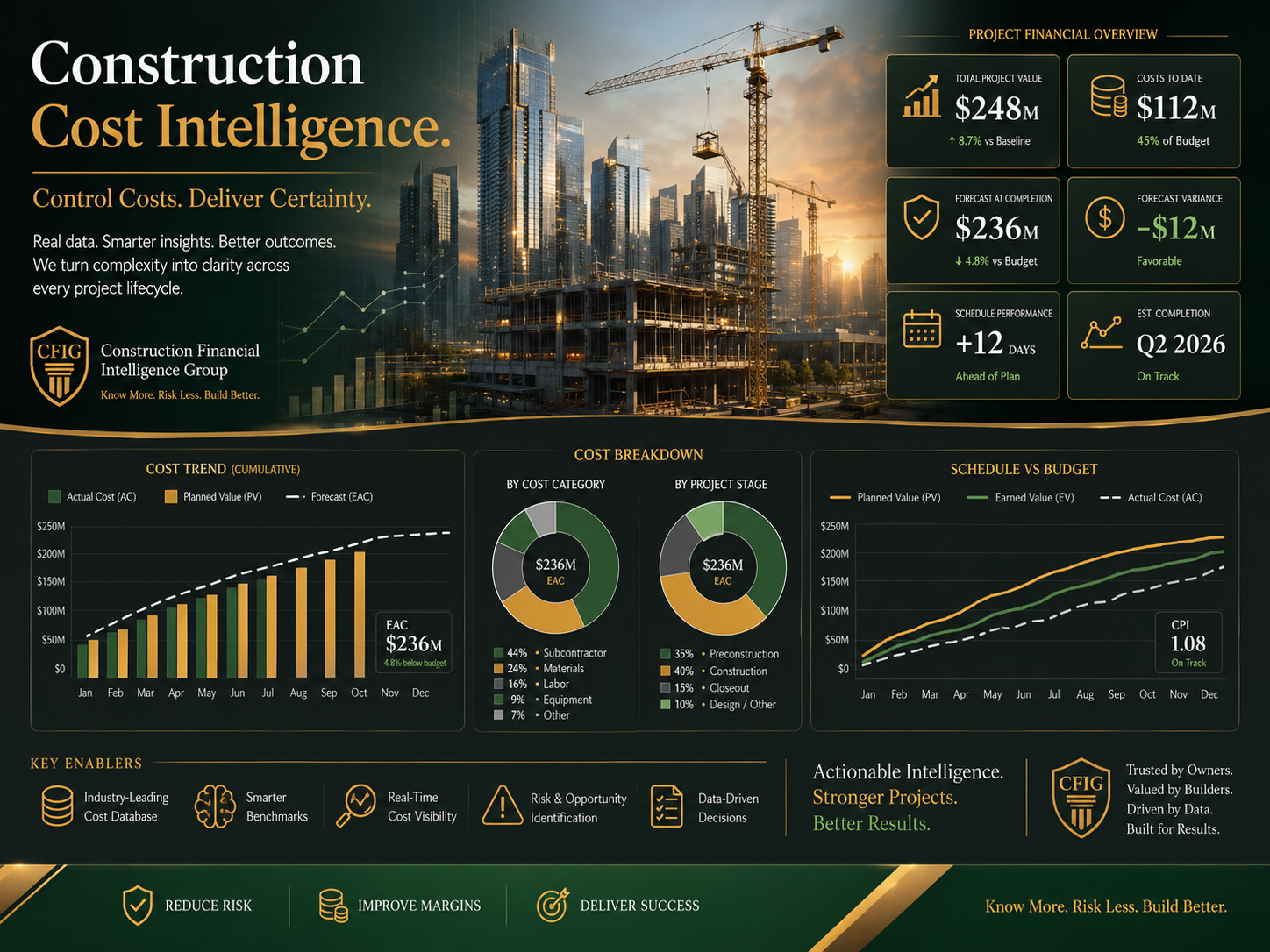
Published industry research demonstrates that cost growth, delay, rework, documentation weakness, disputed costs, and project-control friction remain persistent construction conditions.

Cost Overruns, Rework, and Documentation Gaps Are Industry-Wide Conditions

These benchmarks provide context. CFIG does not assume that any benchmark applies to a particular client or project until the relevant evidence is reviewed.

80%

Large construction projects have been reported to experience significant budget growth.

Source: McKinsey & Company
31%

Only a minority of surveyed projects have historically remained close to original budget expectations.

Source: KPMG Global Construction Survey
~5%

Rework is a recognized source of direct project cost across the industry.

Source: Construction Industry Institute
$31B+

Poor communication and missing project information have been associated with substantial annual rework cost.

Source: PlanGrid / FMI Research
The CFIG Mission

The Construction Forensics Intelligence Group Mission

Construction projects lose revenue and capital when important conditions are not identified, documented, clarified, or acted upon in time. Budget changes, schedule pressure, rework, disputed costs, inaccurate data, poor communication, unclear responsibility, and weak project controls can compound into larger losses.

The mission of CFIG is to protect project revenue and capital for leadership across every phase of construction by evaluating project data, decisions, costs, schedules, evidence, and operating conditions. CFIG applies Projection Intelligence, Real-Time Active Intelligence, and Retrospective Intelligence to support better-informed decisions before, during, and after material project events.

CFIG is engineered from professional experience across research, financial controls, compliance, operations, data analysis, systems analysis, logistics, public infrastructure, insurance-related environments, and construction.

Human Integrated Intelligence is the foundation. Human Authority governs conclusions and recommendations.

Find Your CFIG Entry Point

Two Ways to Navigate the CFIG System

Return On Intelligence (ROI) =

Risk Mitigation • Revenue Protection • Capital Protection • Exposure Reduction • Better-Informed Decisions

CFIG's value is established from the client-validated condition, decision, evidence, and outcome. Public materials demonstrate potential value categories; engagement-specific value is established only after review of the authorized record.

Problems We Expose

Where Construction Capital Quietly Disappears

These categories show where CFIG can create decision visibility. Click a condition to see a client-safe explanation without exposing the internal analytical recipe.

The CFIG Process

From Project Conditions to Decision-Ready Intelligence

The public process shows what the client experiences. The proprietary analytical architecture used inside each stage remains inside CFIG.

1

Define the Decision or Exposure

CFIG begins with the business question, project condition, phase, event, or concern leadership needs clarified.

2

Establish the Evidence Posture

Relevant authorized information is evaluated to distinguish what is supportable, incomplete, conflicting, or still unknown.

3

Connect the Business Impact

CFIG connects material findings to the client decision, project exposure, and lifecycle context without treating observations in isolation.

4

Develop Decision Intelligence

Supported findings are translated into client-appropriate implications, decision focus, and potential paths for authorized action.

5

Deliver Institution-Grade Output

Leadership receives a clear intelligence product designed for executive use, appropriate professional review, and the agreed scope.

The specific evidence schema, analytical methods, option-generation logic, thresholds, sequencing, validation architecture, and implementation controls are proprietary CFIG intellectual property and are not published on the public website.
Eight-Phase Construction Intelligence Model

Coverage Across the Full Project Lifecycle

Each phase retains a substantive client-facing explanation while protecting the internal playbook.

See CFIG Applied

Real World Portfolios and Companion Guide

The collection applies CFIG’s public-facing intelligence standard to real-world projects using public records. Each case pairs a guided evidence portfolio with a plain-language companion guide that separates documented facts from retrospective CFIG analysis.

Real Worldportfolios
Companionguide
8lifecycle phases represented
Open Real World Portfolios and Companion GuideCLICK HEREFounder Bio / CVCLICK HERE
Markets We Cover

From Raw Land to Retail Delivery

Services & Outputs

A Service Ladder Engineered for Every Decision Point

Service descriptions show what each engagement is designed to accomplish without publishing the underlying execution method.

Who We Support

Helping Construction Professionals Make Intelligent Decisions That Protect Capital

From institutional ownership to field execution, CFIG supports the people responsible for capital, contracts, risk, documentation, delivery, and project performance.

Tier 1

Enterprise and Institutional

Large public agencies, institutional owners, enterprise contractors, developers, risk organizations, insurers, sureties, and capital partners.

CEO / COO / CFOChief Risk OfficerGeneral CounselSVP ConstructionPortfolio Leadership
Tier 2

National and Regional

National and regional general contractors, construction managers, developers, design-build firms, and their risk and delivery partners.

Project ExecutiveProject ManagerPreconstructionSchedulingRisk Management
Tier 3

Local, Specialty and Independent

Local contractors, specialty trades, owner representatives, independent project professionals, real estate professionals, and dispute-support teams.

SuperintendentField ForemanEstimatorOwner RepresentativeAttorney / Dispute Team
Matrix Factory

Request a CFIG Analysis

A CFIG Matrix is a company-specific executive intelligence package developed from documented public-source signals, operating context, and evidence classifications. Internal project records are evaluated only through an authorized CFIG engagement. Matrix creates relevance. This website demonstrates depth. A conversation establishes the engagement.

Show Me the ExposureCLICK HERE
Evidence Discipline

Institution-Grade Evidence, Not Generic Observations

CFIG distinguishes the strength of the available record from the strength of a conclusion. Public content shows the discipline; internal scoring and validation mechanics remain proprietary.

CFIG distinguishes strong, partial, conflicting, and missing support so leadership understands the evidence posture.
CFIG connects findings to identifiable project records, decisions, responsibilities, and lifecycle context rather than relying on general impressions.
CFIG produces client-safe intelligence designed for executive use and, where appropriate, professional or legal review.
CFIG flags conditions that may require licensed or specialized professional authority and organizes the intelligence for that review.
The same evidence discipline is applied across the lifecycle while the internal scoring, thresholds, and analytical controls remain protected.
Executives reviewing a development model
How CFIG Was Engineered

A Governed Intelligence System, Engineered to Outlast Any One Person

CFIG is engineered on Human Integrated Intelligence: multidisciplinary operating experience, collaborative development, structured research, advanced analytical technology, and human authority. The system integrates construction, procurement, compliance, operations, technology, and cross-domain analysis into a governed capability for identifying hidden loss and project exposure.

The system is the star. The public website explains what CFIG can do and where it applies; the proprietary architecture that makes the system repeatable remains controlled inside TopFlyte.

Human Integrated Intelligence

Human experience, professional judgment, critical interpretation, and accountability remain the foundation of CFIG. Advanced analytical technologies can accelerate organization, comparison, pattern recognition, calculation, and scenario evaluation, but they do not replace human judgment or the authority of the client and responsible professionals.

Where a matter requires legal, engineering, architectural, insurance, accounting, code, environmental, safety, or other licensed or specialized professional authority, CFIG can organize and clarify the intelligence for appropriate review. Technology informs. Human authority decides.

Final Step

Request a CFIG Intelligence Analysis

Tell us your role, phase, concern, and project context. This remains a low-friction first step — not a public disclosure of CFIG's internal intake or analytical method.

Submitting opens a prepared email to CFIG with your selections. Nothing is sent automatically.